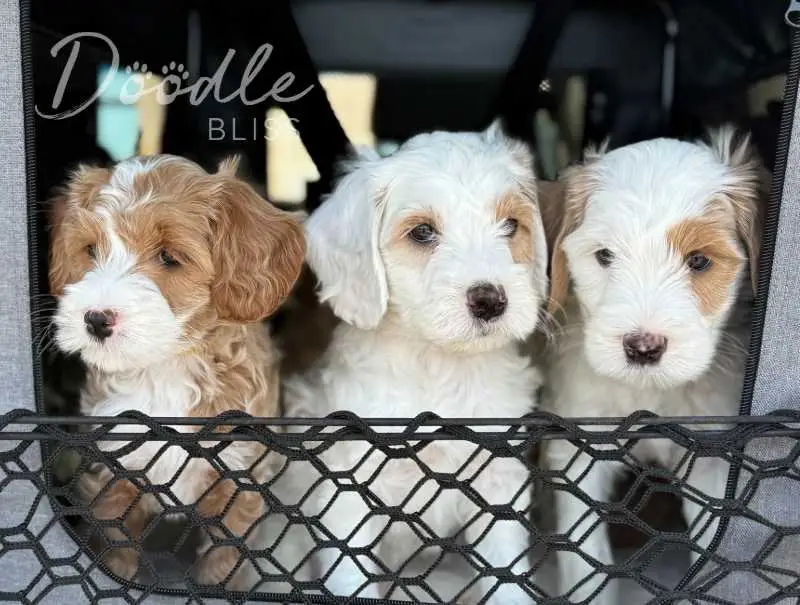
Start shopping for a Goldendoodle and within about ten minutes you’ll hit a wall of letters and numbers. F1. F1B. F2B. Multigen. Every breeder website lists them, most of them explain them differently, and a fair number use them as a sales pitch — our F1B’s are the most hypoallergenic!
Here’s the honest version, from people who raise these dogs in Gilbert, Arizona, and who have watched a lot of families agonize over this decision when they didn’t need to.
Generations are real and they do tell you something useful. But they’re a probability, not a promise — and there’s a more precise tool available now that most generation charts never mention. We’ll get to that.
What the letters and numbers actually mean
The system is borrowed from genetics, and it’s simpler than it looks:
- F stands for “filial” — just meaning a generation of offspring.
- The number is how many generations you are from the original cross.
- B stands for “backcross” — one parent was bred back to a purebred, almost always the Poodle.
So an F1 is a first-generation cross. An F1B is that first-generation dog bred back to a Poodle. That’s the whole code.
What changes as you move along the chain is the percentage of Poodle, and the Poodle is where the curly, low-shedding coat comes from. More Poodle generally means a curlier coat and less shedding — and also more grooming.
The generations, one by one
F1 Goldendoodle — 50% Golden Retriever, 50% Poodle
A purebred Golden Retriever bred to a purebred Poodle. The original recipe.
Coat: Usually wavy or shaggy — the classic teddy-bear look most people picture with low to moderate shedding.
The catch: F1 litters are the most variable. Because both parents contribute a completely different set of coat genes, the same F1 litter can produce puppies ranging from loosely and curly to nearly flat-coated. That flat-coated puppy will shed much like a Golden Retriever. It’s a great dog, smart and amazing temperament, but it is not the dog an allergy family thinks they’re buying.
Best for: Families who want the shaggy look, don’t have allergies, and want a slightly easier coat to maintain than a tight curl.
F1B Goldendoodle — roughly 25% Golden, 75% Poodle
An F1 Goldendoodle bred back to a Poodle.
Coat: Curlier and more consistent. This is the generation most often recommended for families with mild allergies, and for good reason — the odds of a low-shedding, well-furnished coat go up substantially.
The catch: Curl means grooming. An F1B typically needs brushing several times a week and professional grooming every eight to twelve weeks, or it mats. Families who choose an F1B for the coat and then don’t plan for the grooming end up with a shaved dog and a bad time. Our complete grooming guide covers what that routine actually looks like, and the right brush makes more difference than people expect.
One thing to ask: “F1B” technically only tells you a backcross happened — not to which breed. A backcross to a Golden Retriever is also an F1B, and produces a very different dog (75% Golden, much more shedding). It’s uncommon, and reputable breeders specify, but ask.
Best for: Families with mild allergy concerns who want a curlier coat and will commit to the grooming.
F2 Goldendoodle — 50/50, but unpredictable
Two F1 Goldendoodles bred together. Still 50% Golden and 50% Poodle on paper.
Coat: This is where the genetics get messy, most experienced breeders never breed this generation. Second-generation crosses re-shuffle the deck, and an F2 litter can throw the widest range of coat types of any generation — including flat-coated, heavily shedding puppies at a meaningful rate.
Careful breeders don’t breed F2 for exactly this reason. If you’re offered one, ask specifically what coat genetics the parents carry.
F2B Goldendoodle — roughly 62.5% Poodle
An F1 bred to an F1B. More Poodle than an F1, less than an F1B, and generally more predictable than an F2.
Coat: Usually curly to wavy, with good furnishings. A reasonable middle ground.
Best for: Families who want most of the low-shedding benefit without the tightest curl.
F1BB — roughly 87.5% Poodle
An F1B bred back to a Poodle again. Very curly, very low shedding, and honestly quite close to a Poodle in coat care requirements. Sometimes chosen for families with more significant allergy sensitivity.
Multigenerational (F3, multigen) — the modern approach
Any breeding beyond the second generation, usually doodle to doodle, selected deliberately over multiple generations.
This is where good breeding programs have been heading, ours included. Rather than chasing a Poodle percentage, a multigen program selects each generation for the specific traits that matter — coat consistency, temperament, health, structure — and stabilizes them. A well-bred multigen litter is often more predictable than an F1, not less.
That’s the whole point. By the third or fourth generation, a breeder who has been paying attention knows what a given pairing produces, because they’ve seen those genetics play out in adult dogs they raised themselves. The letter code stops being a guess and starts being a track record.
The word “multigen” on its own doesn’t guarantee any of that, though. It’s only as good as the program behind it — which is why the questions further down matter more than the label.
The thing most generation charts get wrong
Here’s what breeders know and most generation charts leave out: the F-number is a shortcut for genetics we can now test for directly.
Coat type in doodles comes down mostly to three genes:
- Furnishings (RSPO2) — this is the big one. Furnishings are the beard and eyebrows that make a doodle look like a doodle. A dog needs at least one copy of the furnishings variant to have that look and the associated low-shedding coat. A puppy with no copies has what’s called an “improper” or flat coat: no beard, straight face, and it sheds like a Golden Retriever.
- Curl (KRT71) — determines whether the coat is straight, wavy, or curly.
- Shedding (MC5R) — influences how much the dog sheds independently of coat texture.
A DNA test on the parents tells you the actual probability of each coat type in a given litter. That is dramatically more useful than a generation label, because it’s the difference between “F1Bs are usually low-shedding” and “both parents carry two copies of furnishings, so every puppy in this litter will be furnished.”
So the question to ask a breeder isn’t just “what generation is this litter?” It’s “what are the parents’ coat genetics, and can I see the results?” A breeder who tests will be glad you asked. A breeder who deflects has told you something useful.
This is also why we DNA test our parent dogs — you can meet them on our doodles page.
What about allergies?
Worth being straightforward here, because a lot of marketing isn’t.
No dog is truly hypoallergenic. The proteins that trigger dog allergies are found in dander, saliva and urine, not just in shed hair. A dog that sheds less spreads less dander around your house, which is why low-shedding breeds are easier for many allergy sufferers to live with — but “easier” isn’t “allergen-free,” and reactions vary enormously from person to person.
What actually helps:
- Choose a generation and coat genotype that reliably produces a furnished, low-shedding coat — F1B and later, or a tested multigen
- Spend real time around the parent dogs before committing. This is the single most reliable test available to you, and it costs nothing
- Be honest with your breeder about the severity of the allergy. A good one would rather redirect you than place a puppy that comes back
If you’re weighing a Goldendoodle against another doodle breed for allergy reasons, our Goldendoodle vs Labradoodle comparison goes through the coat differences in more detail.
Generation doesn’t determine size
Common point of confusion: mini, medium and standard have nothing to do with F1 versus F1B. Size comes from the Poodle in the cross — a Toy or Miniature Poodle produces mini Goldendoodles, a Standard Poodle produces standard ones. You can have a mini F1 and a standard F1B.
Our mini Goldendoodle guide covers the small end specifically, and how big does a Goldendoodle get walks through predicting adult size from the parents.
What we breed at Doodle Bliss, and why
We breed mostly multigenerational Goldendoodles, with some F1B and F2B litters. That’s a deliberate choice, and the reason is consistency.
Everything above about generations comes down to one theme: how predictable is the puppy you’re bringing home? A first-generation litter can hand you six puppies with six different coats. Every generation of careful selection past that point narrows the range — not by chasing a Poodle percentage, but by choosing which specific traits carry forward. Coat, temperament, size, structure, health.
That’s what multigen breeding lets us do. When we pair two dogs whose traits we already know several generations deep, we can tell a family with real confidence what their puppy will look like at two years old, how much it will shed, and what kind of temperament to expect. That’s a very different conversation from “we’ll see what the litter brings.”
You can see how this works in our own program. Our dams are F1 and F1B girls. Our studs include our multigen mini Goldendoodles, Boots and Duke. Pairing an F1B dam with a multigen sire produces a multigen litter with a well-established coat profile. Pairing an F1 dam with a poodle produces an F1B litter. Both are good dogs — we just know more about what we’re going to get from the first one.
Every parent dog is DNA health and genetic tested. We’re happy to walk any family through exactly what a specific pairing is likely to produce, coat included, before you commit to anything.
See our current litters, or get in touch and we’ll talk through which pairing fits your family.
Questions to ask any breeder about generation
Take these with you, whoever you end up buying from:
- What generation is this litter, and what are both parents?
- If it’s an F1B, was the backcross to a Poodle or a Golden Retriever?
- Have the parents been DNA tested for coat genetics — furnishings, curl and shedding? May I see the results?
- What range of coat types do you expect in this litter?
- What health testing have both parents had?
A breeder who answers all seven without hesitation is worth your deposit. One who gets vague around three and five may need a deeper look.
So which generation should you choose?
If we had to compress this into one paragraph: if nobody in your house has allergies and you want the classic shaggy teddy-bear look with manageable grooming, an F1 is a great dog. If there are mild allergies, or you want a curlier coat and you’re realistic about the grooming, look at F1B, F2B, or a well-bred multigen. And in every case, ask about coat genetics rather than relying on the letter code alone — because a tested dog from a careful program will serve you better than an untested F1B from someone using the label as marketing.
The reason we’ve moved most of our program to multigen is that it collapses the guesswork. The letter code tells you a probability. A multigen pairing from dogs we know several generations deep tells you what you’re actually getting.
For the full picture on living with one of these dogs — health testing, nutrition, training, grooming and the first twelve weeks — start with our Ultimate Goldendoodle Guide. If you’re at the very beginning, what is a Goldendoodle is the place to start.
Frequently asked questions
Which Goldendoodle generation sheds the least?
Generally the ones with the highest Poodle percentage — F1B, F1BB, and well-selected multigens. But shedding is driven by specific coat genes, so a DNA-tested dog of any generation is a more reliable guide than the generation label by itself.
Is an F1 or F1B Goldendoodle better?
Neither is better — they’re different. F1s tend to have a wavier, lower-maintenance coat and are the classic shaggy look. F1Bs are curlier, shed less, and need more grooming. The right answer depends on your allergy situation and how much grooming you’ll realistically keep up with.
What is the healthiest Goldendoodle generation?
There’s no generation that is reliably healthier than the others. First-generation crosses are often credited with hybrid vigor, though how much benefit that provides is debated. Health comes overwhelmingly from what the breeder tests for and selects against, not from the F-number.
What does the B mean in F1B?
Backcross — one parent was bred back to a purebred, nearly always a Poodle. An F1B Goldendoodle is an F1 Goldendoodle crossed with a Poodle, making it roughly 75% Poodle.
Are F1B Goldendoodles hypoallergenic?
No dog is truly hypoallergenic. F1Bs shed less than F1s on average, which means less dander distributed through your home and an easier time for many allergy sufferers — but individual reactions vary, and spending time with the parent dogs is the only real test.
What generation is best for allergies?
F1B or later, or a multigen with tested coat genetics, gives you the best odds. Confirm the parents’ furnishings and shedding genotypes with the breeder, and spend time around the adult dogs before you commit.